
Peptide Guide
How to Reconstitute Peptides: Step by Step Practical Guide
Executive Brief
Reconstitution is the process of mixing lyophilized (freeze-dried) peptide powder with bacteriostatic water to create an injectable solution. Getting this right affects your dosing accuracy, peptide stability, and safety. This guide walks through the entire process with exact measurements, storage rules, and injection techniques. ---
Step-by-step protocol
Where reconstitution knowledge comes from
Peptide reconstitution borrows directly from insulin preparation, which has been standard medical practice for over 40 years. Insulin users have been reconstituting, drawing, and injecting peptides since the 1980s. The equipment is identical: insulin syringes, bacteriostatic water, and sterile vials. The peptide community adapted these techniques for research peptides starting in the early 2010s. Early adopters learned the hard way that not all peptides reconstitute the same way. Some dissolve instantly. Others require gentle rolling and patience. Agitation, meaning shaking or vigorous mixing, can damage fragile peptides. Online forums and YouTube tutorials standardized the process. The community settled on bacteriostatic water (BAC water) as the universal solvent, insulin syringes as the delivery method, and refrigerator storage as the default. These conventions are now well established across the peptide world.
How reconstitution works
Lyophilized peptides are stored as dry powder in sealed vials under vacuum. The powder is stable at room temperature for months, sometimes years. Once you add water, the clock starts. The dissolved peptide degrades over time, losing potency. Bacteriostatic water is sterile water with 0.9 percent benzyl alcohol added as a preservative. The benzyl alcohol prevents bacterial growth for up to 28 days after opening. Regular sterile water works in a pinch but offers no bacterial protection once the vial is punctured. The reconstitution process itself is straightforward. You inject BAC water into the peptide vial, let it dissolve, then draw your dose with an insulin syringe. The tricky part is the math, which we will cover in detail. Step 1: Gather your supplies
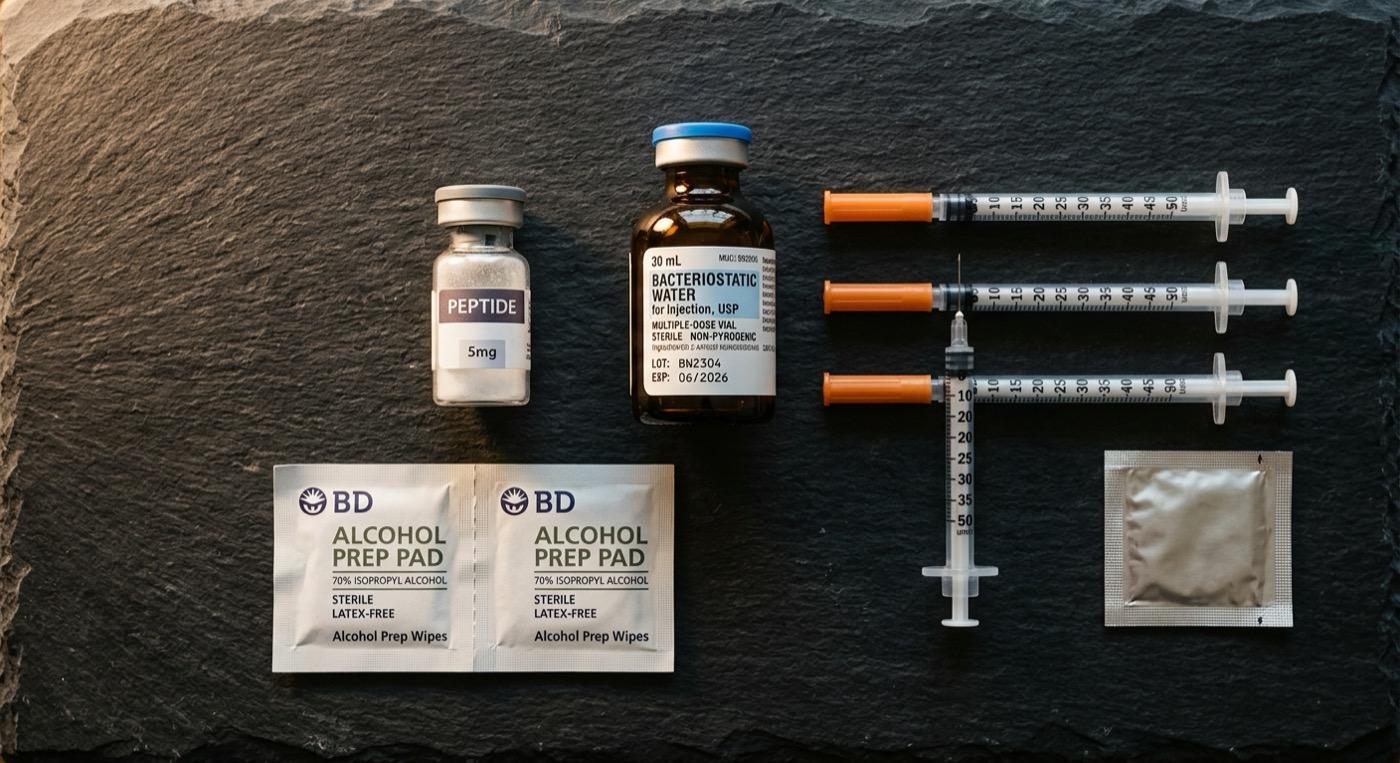
- Lyophilized peptide vial
- Bacteriostatic water (BAC water)
- Alcohol prep wipes
- Insulin syringes (typically 29 to 31 gauge, 0.5cc or 1cc)
- A clean workspace
Step 2: Clean everything Wipe the top of the peptide vial and the BAC water vial with an alcohol swab. Let them dry for about 10 seconds. Wipe your injection site if you are about to inject. Step 3: Draw BAC water into the syringe Pull back the syringe plunger to draw air equal to the volume you need. Insert the needle into the BAC water vial, inject the air (this equalizes pressure), then turn the vial upside down and draw the water. Pull slowly to avoid bubbles. Step 4: Add water to the peptide vial Insert the needle into the peptide vial at an angle. Let the water run down the inside wall of the vial. Do not spray it directly onto the peptide powder. Direct force can damage fragile peptides. Slow and gentle is the rule. Step 5: Let it dissolve Set the vial down and let it sit. Most peptides dissolve within 1 to 3 minutes. You can gently roll the vial between your palms to help. Never shake a peptide vial. Shaking causes foaming and can denature the peptide. If there are still clumps after 5 minutes, let it sit longer. Some peptides take 10 to 15 minutes. Step 6: Calculate your dose This is where most people get confused. Let me break it down with examples.

Bacteriostastic water ratios
The Math: From Vial to Syringe Step by Step
This is where most people get confused. Let me walk through exactly how you go from a vial with 10mg of powder to drawing 30 units on a syringe for your 250mcg dose. Once you see it, it clicks.
Step 1: Understand what is in the vial. Your vial says "10mg" on the label. That means there is 10 milligrams of lyophilized peptide powder inside. That is the total amount. It does not change. Whether you add 1mL or 3mL of water, there are still 10mg of peptide in that vial.
Step 2: Understand what BAC water does. When you add bacteriostatic water, you are dissolving the powder into a liquid. The peptide is now spread evenly throughout the water. Think of it like dissolving sugar in coffee — the sugar is still there, it is just mixed into the liquid. The more water you add, the more diluted the peptide becomes.
Step 3: Convert to the same units. An insulin syringe is measured in "units." 100 units = 1mL. So if you add 2mL of BAC water to your vial, you now have 200 units of liquid containing 10mg of peptide. We need to work in micrograms (mcg) because doses are usually small. 10mg = 10,000mcg.
Step 4: Find the concentration. Concentration means "how much peptide is in each unit of liquid." Concentration = Total peptide ÷ Total units. In this example: 10,000mcg ÷ 200 units = 50mcg per unit. Every unit on your syringe now contains 50mcg of peptide.
Step 5: Calculate your dose. Your target dose is 250mcg. Units to draw = Desired dose ÷ Concentration. So: 250mcg ÷ 50mcg per unit = 5 units on the syringe. You draw to the "5" mark on your insulin syringe. That is your 250mcg dose.
Worked Examples
Example 1: 5mg vial + 1mL BAC water + 250mcg dose
Total peptide: 5mg = 5,000mcg. Total liquid: 1mL = 100 units. Concentration: 5,000 ÷ 100 = 50mcg per unit. Dose: 250 ÷ 50 = 5 units on the syringe.
Example 2: 10mg vial + 1mL BAC water + 1mg dose
Total peptide: 10mg = 10,000mcg. Total liquid: 1mL = 100 units. Concentration: 10,000 ÷ 100 = 100mcg per unit. Dose: 1,000mcg ÷ 100 = 10 units on the syringe.
Example 3: 5mg vial + 2mL BAC water + 250mcg dose
Total peptide: 5mg = 5,000mcg. Total liquid: 2mL = 200 units. Concentration: 5,000 ÷ 200 = 25mcg per unit. Dose: 250 ÷ 25 = 10 units on the syringe.
Example 4: 2mg vial + 1mL BAC water + 200mcg dose
Total peptide: 2mg = 2,000mcg. Total liquid: 1mL = 100 units. Concentration: 2,000 ÷ 100 = 20mcg per unit. Dose: 200 ÷ 20 = 10 units on the syringe.
The general rule: Adding less water creates a more concentrated solution (fewer units per dose, harder to measure precisely for small doses). Adding more water creates a less concentrated solution (more units per dose, easier to measure). For doses under 500mcg, use less water so you are not drawing tiny amounts like 2 or 3 units.
Use the calculator above to skip the math entirely. Enter your vial size, how much BAC water you added, and your target dose. It will tell you exactly how many units to draw.
How to inject
Subcutaneous injection is the standard method for most peptides. Here is the process. Injection sites:
- Belly fat, at least 2 inches from the navel
- Love handles (flanks)
- Outer thigh
- Back of the upper arm
Rotate sites. Do not inject in the same spot every time. This reduces the chance of lipohypertrophy (fat buildup at injection sites). The injection itself:
- Pinch a fold of skin at your chosen site.
- Insert the needle at a 45 to 90 degree angle. Most people use 90 degrees for insulin syringes since the needles are short (8mm).
- Inject slowly. Do not rush it.
- Release the pinch, then withdraw the needle.
- Apply light pressure with an alcohol swab if there is a drop of blood.
Intramuscular injection is occasionally used for specific protocols but is not necessary for most peptides. Subcutaneous is easier, less painful, and works just as well for peptides that do not require rapid absorption.
How it feels
A user on r/Peptides shared: “I was terrified of needles before starting peptides. Watched about 10 YouTube videos before my first injection. The 31-gauge insulin needles are so thin I barely felt it. First time I barely got the needle in because I was hesitating. By the third injection it was routine. Takes me 2 minutes total now.“ Another user on r/Peptides wrote about a reconstitution mistake: “I shook my first vial like a protein shake. The peptide came out cloudy and did not work as well. Later learned that shaking damages peptides. Gentle rolling only. Lesson learned the expensive way.“
Benefits you will notice
- Accurate dosing when you do the math correctly
- Longer peptide shelf life when stored properly
- Fewer injection site reactions with proper technique
- Better peptide potency when you avoid shaking during reconstitution
- Reduced contamination risk with sterile technique
Storage and stability
Reconstituted peptides go in the refrigerator, always. The cold slows degradation. Most reconstituted peptides are stable for 2 to 4 weeks in the fridge. Some degrade faster. Here is a rough stability guide for reconstituted peptides stored at 2 to 8 degrees C (refrigerator):
- BPC-157: 2 to 3 weeks
- CJC-1295 (no DAC): 2 to 3 weeks
- Ipamorelin: 2 to 3 weeks
- TB-500: 2 to 4 weeks
- GHK-Cu: 4 weeks (more stable than most)
- Semaglutide: 4 weeks (pharmaceutical stability data exists)
Lyophilized (dry) peptide vials should be stored in the refrigerator or freezer. Room temperature is acceptable for a few months but not ideal. Avoid heat and direct sunlight. Never freeze a reconstituted peptide, the freeze-thaw cycle degrades it.
Frequently Asked Questions
What is bacteriostatic water and can I use regular sterile water?
Bacteriostatic water is sterile water with 0.9 percent benzyl alcohol added as a preservative. It inhibits bacterial growth for up to 28 days after the vial is first punctured. Regular sterile water has no preservative. You can use it, but the peptide solution must be used within 24 to 48 hours to avoid bacterial contamination. BAC water is the safer choice.
How much BAC water should I add to my peptide vial?
There is no single right answer. Adding 1mL to 2mL is standard for most vials. The amount you add changes the concentration, not the total amount of peptide. Adding 1mL to a 5mg vial gives you 50mcg per unit. Adding 2mL gives you 25mcg per unit. Choose an amount that makes your target dose easy to measure on the syringe.
Can I mix two peptides in the same syringe?
In general, no. Different peptides may have different pH requirements and stability profiles. Mixing them can cause degradation or unexpected interactions. Draw and inject each peptide separately. Use a new needle for each if you are concerned about cross-contamination, though this is a minor risk with separate injection sites.
What happens if I see bubbles in my syringe?
Small bubbles are normal and harmless for subcutaneous injection. They do not pose the embolism risk associated with intravenous injection. You can minimize bubbles by injecting air into the vial before drawing (equalizing pressure) and drawing slowly. If bubbles appear, tap the syringe to move them to the top, then push them out before injecting.
Why is my peptide not dissolving completely?
Some peptides are more resistant to dissolution. Let the vial sit for 10 to 15 minutes at room temperature. Gently roll it between your palms. Avoid shaking. If there are still particles after 15 minutes, the peptide may have degraded during shipping or storage, or it may be a lower purity product. Cloudy solutions or persistent floaters are a sign to discard the vial.
Research Disclaimer
All content on this page is provided for informational and research purposes only. Nothing here constitutes medical advice, diagnosis, or treatment recommendation. Always consult a qualified healthcare professional before using any compound.